
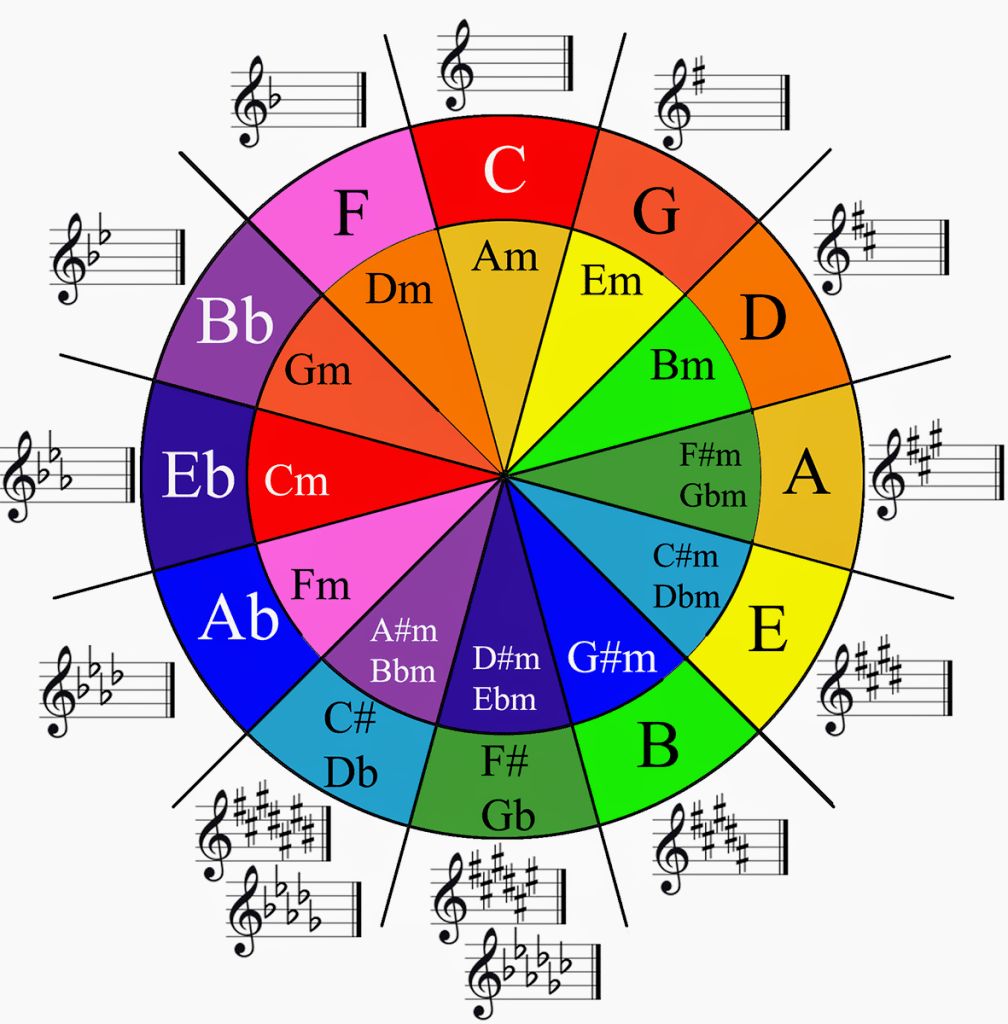
How to use the Circle of Fifths to write songs!
The Circle looks much like a clock. Just like there are 12 hours on a clock, there are 12 notes on the Circle.
The Circle of Fifths isn’t a technique like modulation or chord substitution. It’s a way of understanding the essential elements of western music: the notes, the intervals, the chords, and the relationships between them.
It’s the relationships between chords that make a chord progression. Referring to the Circle of Fifths can help you discover interesting chord progressions, particularly when you’re stuck for what the next chord wants to be.
Moving clockwise, each note is a fifth above the last one. A fifth, as we know, is the third note of a major or minor triad (3-note chord), and the fifth note of any major or minor scale. For example, the C-major chord is C-E-G. The G is a fifth above C, and one “hour” past C on the Circle of Fifths. Similarly, an A-major chord is A-C#-E. The E is a fifth above A, and one segment after A on the Circle. This pattern holds true for any starting point on the Circle of Fifths. And it comes full circle; if you start on C and go up a fifth 12 times, you’ll be back to C.
Why are fifths so important in music?
How many songs in C use a variation of these 6 chords?
Many popular songs use only 3 or 4 of them. Now look at the Circle of Fifths. The chords touching the C-major are the other five major and minor chords in the key of C major.
Just like the notes, this hold true for whatever key you’re in, or your base starting point on the Circle. In the key of G, all the chords touching the G correspond to the other major and minor chords in that key.
We hope this will help you in writing songs.
Musical Greetings