
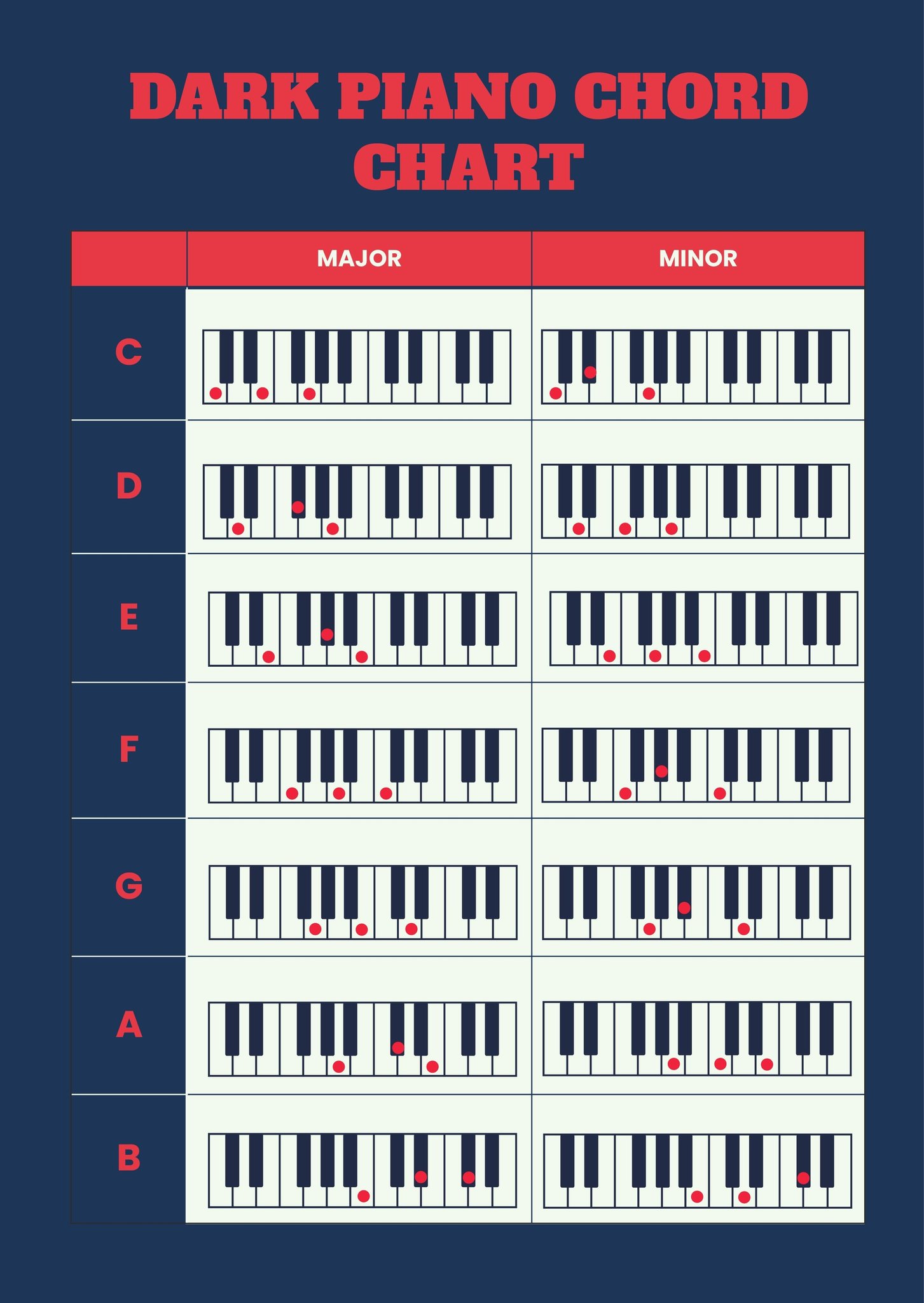
Dark piano chords are perfect for emotional, cinematic, or moody music. These chords often use minor intervals, dissonance, and low voicings. Let’s explore how to build and play them.
1. What Makes a Chord “Dark”?
Dark chords typically include:
Minor thirds or minor sevenths
Dissonance (clashing notes)
Low register playing (left side of the keyboard)
Unresolved or unstable sounds
2. Basic Dark Chords to Know
A. Minor Chords
The simplest dark-sounding chords.
Formula: Root + Minor 3rd + Perfect 5th
Example: A Minor
Notes: A – C – E
Keyboard Diagram:
A (white key)
C (white key)
E (white key)
B. Diminished Chords
Even darker and more unstable.
Formula: Root + Minor 3rd + Diminished 5th
Example: B Diminished
Notes: B – D – F
C. Minor 7th Chords
Adds depth and emotion.
Formula: Root + Minor 3rd + Perfect 5th + Minor 7th
Example: D Minor 7
Notes: D – F – A – C
3. Special Dark Chords
A. Minor Add9
Haunting and cinematic.
Formula: Minor chord + Major 9th
Example: E Minor Add9
Notes: E – G – B – F#
B. Suspended and Dissonant Chords
Create tension.
Example: Csus2
Notes: C – D – G
Example: CminMaj7
Notes: C – Eb – G – B
4. Tips for Dark Sounding Progressions
Stay in minor keys (A minor, D minor, etc.)
Use inversions for smoother, haunting transitions.
Play chords in lower octaves for rumble and darkness.
Combine dark chords with slow tempo and deep sustain.
5. Sample Progression (Try This!)
Progression: Am – F – Dm – E
Emotionally intense, commonly used in dark pop or film scores.