
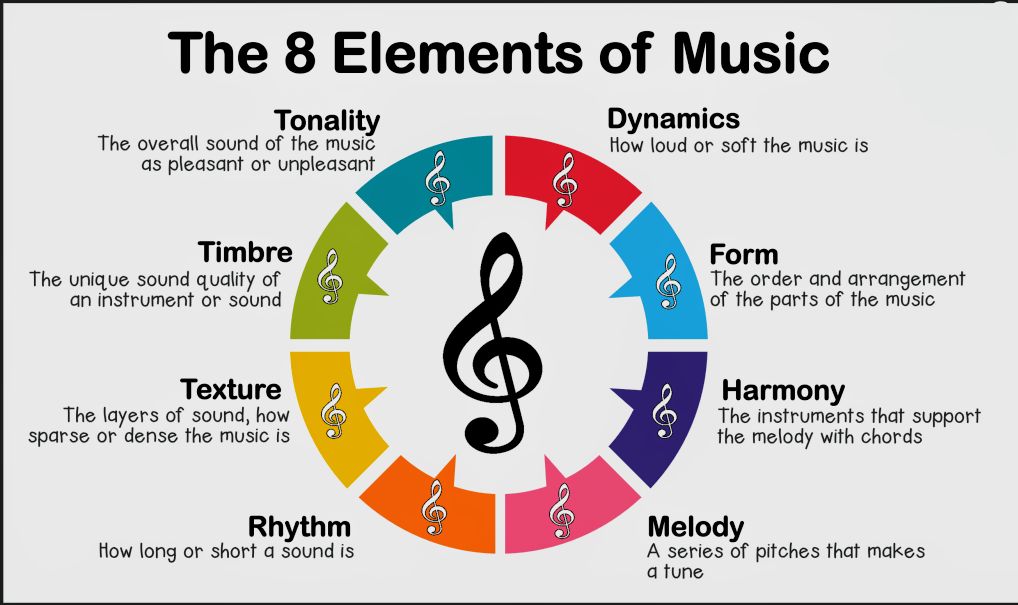
Element of Music – Dynamics
Dynamics refers to the volume of a piece of music. Music can be described as loud, or soft, or there could be gradual changes from loud to soft, or soft to loud, depending on the performer’s interpretation of the music. There are several Italian music terms that are used to describe the dynamics of a piece of music.
Element of Music – Form
The Form or Structure of a piece music refers to the order and arrangement of the different parts. Music vocabulary such as introduction, verse, chorus, bridge, solo, in and outro are common music terms that can be used to describe most rock or pop music. There are several more musical definitions for many more different types of musical form and structure used in classical music
Element of Music – Harmony
The simple definition of musical harmony is the sound created when two or more pitches are performed at the same time to form a chord. In modern music, the harmony often comes from instruments like the guitar and piano. These instruments often play chords that support the main melody, which is typically performed by a singer. Other pitched instruments like the bass contribute and support the harmony by providing a basis of support for both the melody and the chordal accompaniment.
Element of Music – Melody
The definition of a melody is a series of pitches that make a tune. In most popular music today, the melody is like an egg, it is the binding agent that holds all the elements of music together in a piece of music. The melody is the part that people remember and will sing along to when listening.
The melody determines the harmony and tonality of the piece of music. The main melody can be heard when it is played by an instrument that has a unique timbre or tone color/quality. If the melody is meant to be happy or sad, it can drive the rhythm of the piece of music and set the tempo.
Element of Music – Rhythm
Rhythm in music includes several different aspects, and some prefer to use the term duration. A simple definition of this musical term is to describe how long or short a sound is. This means describing the notes of any given instrument in a piece of music as mainly long or sustained, or short.
Within this musical element, other terms are included. Tempo for example refers to the speed or pace of music. The term meter refers to the type of time signature used in the music. All these terms will be explained in further detail in another blog post.
Element of Music – Texture
Texture in music refers to the number of instruments or voices that contribute to the overall density of the music. If there are only a few instruments playing, like a duet for example, then the music can be described as thin or sparse. On the other hand, if there are several instruments performing together, like in an orchestra, the piece can be described as either thick or dense. Texture also refers to the layers of sound in a piece of music, these layers are named by their role within a piece of music.
There are several specialized terms that are used to describe the type of texture used in a piece of music. These include monophonic, homophonic, heterophonic and polyphonic.
Element of Music – Timbre
Timbre in music refers to the unique sound quality of an instrument. For example, a nylon string guitar and a steel string guitar each have a unique sound, and just by hearing them we can determine the instrument. Timbre can also be described using the term tone color. Just like in a painting and the use of different color creates different images, the “color” of an instrument is like painting sound for our ears to hear. Every instrument and voice have their own unique sound, and it is this quality that makes a piece of music unique.
Under the banner of timbre and tone color, is another term – performing media. Performing media refers to the instruments used in a piece of music and the action used to produce a sound. This action is then used to classify an instrument into groups like the string family, brass family, woodwind family, percussion family and voices. There are several other ways to classify instruments with other terms like aerophone, chordophone, membranophone, idiophone and electronic sound.
Timbre, performing media and tone color also describes the role of the instrument in a piece of music. Is the instrument performing the melody, beat, rhythmic accompaniment, chordal accompaniment or harmonic accompaniment?
Element of Music – Tonality
Tonality in music refers to the overall sound of the music. Is the music mainly pleasant sounding (consonant) or unpleasant sounding (dissonant)? Or is the music in a major, minor key? Often a lot of world music has a tonality based on an unusual scale like the medieval modes, or Indian raga.
The Concepts of Music
Depending on where you are in the world, some people use the term “Concepts of Music” instead of the Elements of Music. In this case, the Concepts of Music are, in alphabetical order – Duration, Dynamics and Expressive Techniques, Pitch, Structure, Texture and lastly Tone Colour.
If you are studying music using these terms, below is a brief definition of each.
• Duration – how long or short a sound is. This is the same as Rhythm in the Elements of Music.
• Dynamics and Expressive Techniques – dynamics refers to how loud or soft the music is. Expressive techniques refers to the articulation and unique sound production methods of an instrument. For this concept of music, mostly Italian terms are used, such as forte, pianissimo, rallentando, pizzicato, mordent, trill, crescendo and many, many more.
• Pitch – how high or low a sound is. Under the umbrella of this concept of music are the musical elements of harmony, melody and tonality.
• Structure – the order and arrangement of the parts of the piece of music. The element of music equivalent is the musical term – form.
• Texture – how sparse or dense the music is. It is the same as the Element of Music – texture.
• Tone Colour – the instruments used in a piece of music. This concept of music uses the element of music Timbre, but also includes performing media.